Moving Forward with a new President and Great Enthusiasm for 2026
Kayenta Connection January 2026
Transition is often challenging, yet it can also offer great opportunities. As a relatively young non-profit tackling a very large and challenging problem—the hazards of tamarisk in our communities—the Desert Preservation Initiative has faced and continues to face a variety of issues.
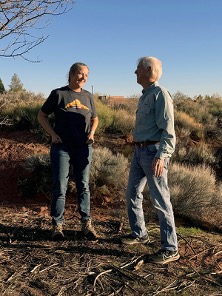
As anyone who works with a non-profit is well aware, these demands include communicating with and educating potential audiences, volunteers and relevant government agencies about both the organization’s needs and successes. DPI is beyond fortunate that as President and Founder Chuck Warren steps down, incoming President Deonne Knill brings 25 years of experience in engineering and environmental cleanup, not to mention great energy and enthusiasm, to her new role.
“Deonne is kind, thoughtful, and not full of herself,” says Warren. “She relates well and connects well. She is efficient and wastes no time. DPI couldn’t be in better hands.”
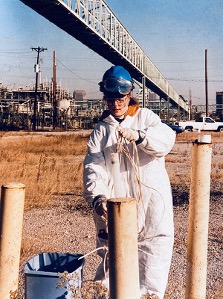
Knill’s extensive experience draws on both hands-on field work and project management. In the field, she worked in full body protective suits, goggles, and a respirator cleaning up properties that were impacted by legacy operations. Before the creation of environmental regulations, it was a common practice to dispose of used chemicals, such as degreasers and oils, directly on the ground. One of her projects included “removing old, corroded, buried steel drums that were full of mystery substances that covered almost every color of the rainbow and with flammability that required non-sparking tools and fully encapsulated suits.” As she says, “Those were some wild days of hot and dangerous work but ones that thrived on good communication and our focus on safety of our staff and the environment.”
Knill also worked in environmental compliance where she partnered with manufacturing companies to audit their operations for compliance with local, state, and federal regulations. In that period, she “spent a lot of time at airports, marine ports, paper printing operations, and steel fabrication, to name a few.”
While she believes that as a whole, people appreciate the need for clean air, soil, drinking water, and surface water, “What people do not understand is the science and complexity of cleaning up properties in a way that finds the balance between cost, efficiency, effectiveness, and safety.” To DPI, she brings direct experience in the negotiations between those responsible for cleanup activities and the governing agencies who approve and oversee them—negotiations that can be delicate.
In multiple ways, her experience is, she says, “a perfect fit” for her new role with DPI. The focus on health and safety she prioritized working in heavy industry translates directly to DPI’s field work. Beyond that, “I have experience working with multiple stakeholders to successfully complete projects. My overall passion for restoring the natural environment fits right in with this wonderful group of people and our community.”
Looking ahead, Knill wants to build on DPI’s success of “completing tamarisk removal on 30+ projects within our immediate community and our ongoing monitoring for re-growth alongside our restoration efforts.” Her immediate focus will be on building strength in the group’s outreach, education, and fundraising efforts.
Noting that “tamarisk removal is very labor intensive,” and that much of the work involves hauling out debris and bringing in water to support new native tree seedlings, Knill looks to obtain the tools to expand access to hard-to-reach areas. “It’d be great if we had a 4-wheeler to help with access,” she says. “And frankly, we need more volunteers who like hard work!”
Another goal is “to expand our relationships and work further into the Santa Clara River watershed area.” And in the fundraising arena, “We really need donors to help us expand our education, outreach, and buy equipment to support our work.”
But Knill is not content to look at just the immediate future. She also has set her sights beyond 2026, when she “sees us partnering with local engineering firms to bring in more expertise, membership, volunteers, and fundraising opportunities. I’d love to see us working with Native Plant Rescue of Southern Utah, Utah State Parks, BLM, and the tribal communities.”
When she isn’t volunteering with DPI, you’ll find her running and hiking the trails around St. George and working in her yard.