Building Community Through a Community Project
Winter 2023
Becky Warren was working in a library in Portland, Oregon, when she ran across a magazine article about a place called Kayenta. She and husband Chuck decided to visit—a trip that left them with “our mouths dropped open” and a plan to return when they retired.
Attracted by the sense of community and rural atmosphere, they bought a lot in the Ivins community in 2014. Not too long after, Chuck, who had built trails into the forest from his family farm in Oregon, found himself building a trail through the Kayenta Wash, something developer Terry Marten had always wanted.
As a trail builder, one drawn to the spiritual nature of wild places, Chuck, spent nearly two years building steps in the Kayenta Wash, regularly joined in the work by interested friends. But progress was impeded by heavy growths of a plant he’d never heard of that made walking impossible in some areas. When he learned about the invasive species tamarisk, he began to realize the enormity of the challenge these trees present—not only to trail building, but, because of the added risk of fire, to the safety of the Kayenta community and the city of Ivins. It became apparent that removing tamarisk was another huge job he had not anticipated, but one that need to be addressed.
“If people understand the enormous fuel load these trees present there would be no question of their support,” Chuck says. “I’ve seen forests in South America, Central America, and Southeast Asia and by comparison, tamarisks are mind-blowing in terms of the fire danger sitting there.” Much of that danger comes from laddering, Becky explains, where the debris accumulated under the trees serves as fuel for a fire. “You can’t even walk through the intertwined branches of the tamarisk,” she adds, but there are air pockets that allow a fire to rise swiftly in such a setting.
These concerns prompted Chuck to begin discussing efforts to remove tamarisk with members of what had become the Kayenta Trail Builders group. Working in the Wash, tangling with the tamarisk, and learning about the fire danger prompted a move to formalize efforts to take on this issue. Thus,the Desert Preservation Initiative (DPI) was born with Chuck Warren as President.
Joining the early efforts were Terrence Walters, Carrie Wilson, Dan Beck, Wayne Pennington, and Kim Wheatley, among others. Discussions revolved around the nature and scope of the group’s mission, a plan for identifying where tamarisk infestations exist in Kayenta, and the need to identify homeowners whose properties were directly affected and build relationships with the Architectural Control Committee (ACC) and the Landscaping Committee, who oversee planting and plant removal. “We wanted to create a philosophy that would carry us as we move forward,” Chuck says.
Other tasks involved educating the community about the problem, recruiting volunteers, and setting up systems for communication, membership and more. Training and safety issues were also addressed, as the group worked to identify the best tools for the work and how to handle and dispose of cut debris. This all led to filing paperwork and eventually receiving approval from the state for DPI to operate as an officially recognized 501(c)(3) non-profit.
A big part of the work involved defining and documenting initiatives in keeping with the organization’s mission, as the process of tamarisk removal involves multiple steps, from planning safe ingress and egress from a property to managing debris removal, spraying herbicide to stop regrowth, monitoring removal sites for regrowth, and guiding homeowners on revegetation plans. To that end, Terrence Walters, DPI botanist, is working with the Landscaping Committee to develop a native plants database.
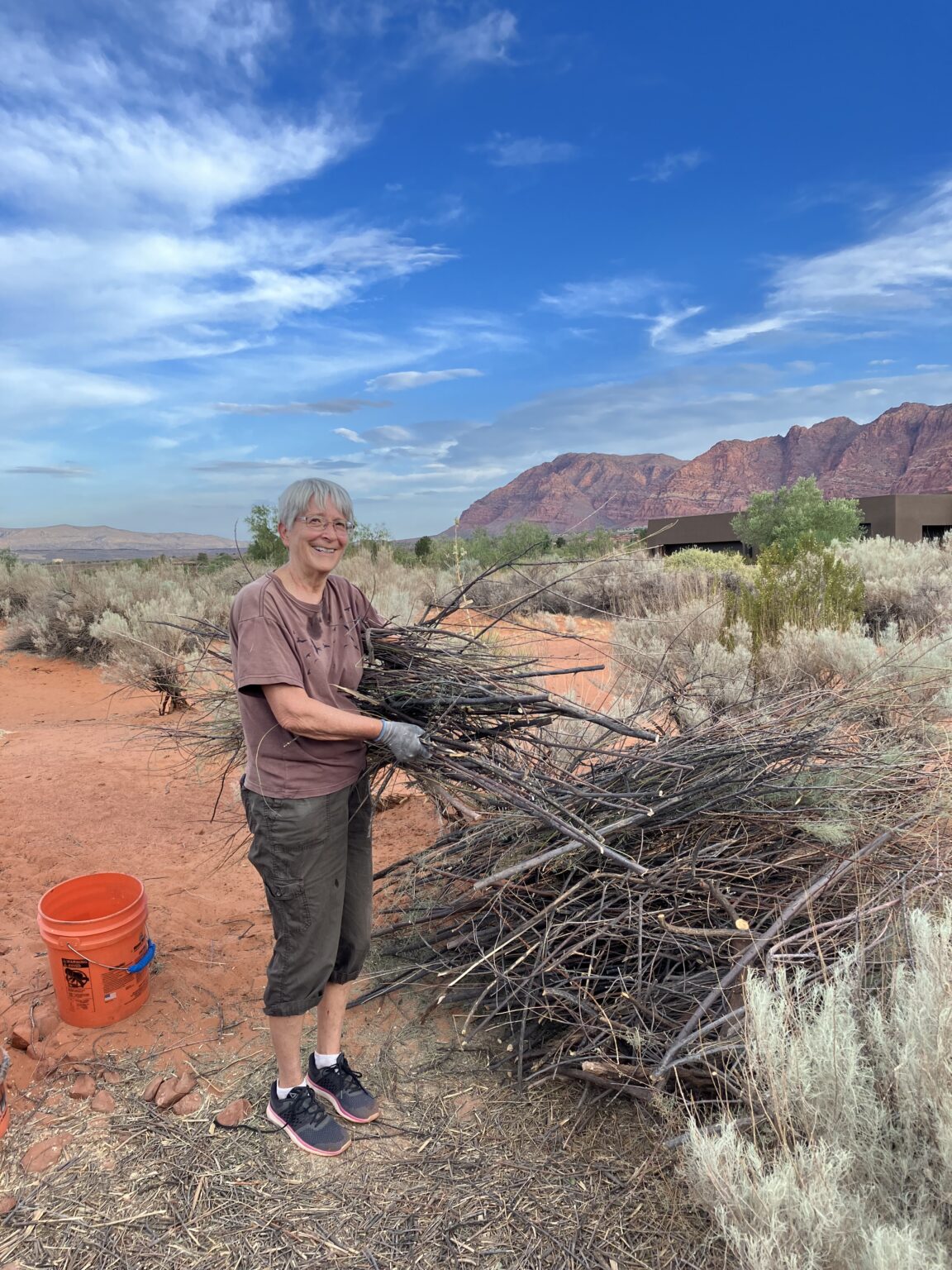
And then, of course, actually doing the work requires a lot of human labor. With eight homes currently approved for tamarisk removal—which Chuck calls a clear marker of success so far—there is plenty of cutting, chopping and hauling to do. Becky Warren has broken all kinds of records by putting in over 450 hours carrying tamarisk cuttings out of the wash. “It’s my exercise every morning,” she says. “I get out and enjoy the clouds, the snow, the animals, and talking to people who come by. My legs and arms are stronger and I’m healthier than I’ve been in a long time.” “She’ll live to be 120,” Chuck adds, smiling.
Perhaps even more gratifying for this driven couple is the sense of community that project has engendered. Typically, they note, people in Kayenta get to know their immediate neighbors while out for a walk. But working with DPI has pulled together people from all of the Kayenta neighborhoods and other parts of Ivins as well. “We see a family forming around this monumental project,” says Chuck, “of highly energetic, very talented people.”
“We are building a real community,” adds Becky, which, she says, is exactly one of the key reasons they moved here in the first place.